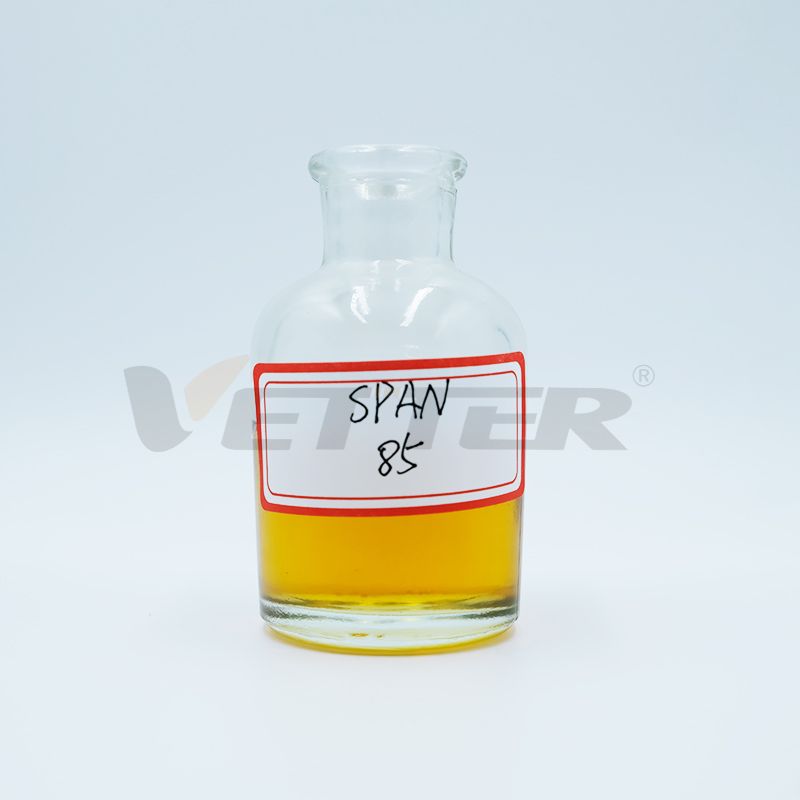
Span 80 technical specifications determine whether a batch will form a stable emulsion, meet safety requirements, and perform consistently in production. Span 80 is also known as sorbitan monooleate, a nonionic surfactant used in cosmetics, food processing, pharmaceuticals, coatings, and industrial formulations.
Buyers often compare only the price per kilogram. This approach can lead to poor emulsification stability, odor problems, color changes, or failed quality tests. A complete review should include the HLB value, acid value, saponification value, iodine value, water content, appearance, and storage conditions.
A reliable Span 80 supplier should provide a current certificate of analysis for every production lot. The certificate should match the agreed product grade and test methods.
Before purchasing Span 80, check the chemical identity, CAS number 1338-43-8, HLB value of about 4.3, appearance, color, acid value, saponification value, iodine value, hydroxyl value, moisture, viscosity, purity, packaging, batch traceability, and regulatory documents. Ask for a certificate of analysis, safety data sheet, specification sheet, sample, and test report. Confirm that the material is suitable for your application, such as a water-in-oil emulsion, cosmetic formulation, pharmaceutical excipient, or industrial product.
Span 80 is a fatty acid ester made from sorbitan and oleic acid. Its common chemical name is sorbitan monooleate. The CAS number is 1338-43-8. The material is generally supplied as a yellow to amber oily liquid or semi-liquid material at room temperature.
| Item | Typical information to check | Why it matters |
|---|---|---|
| Product name | Span 80 or sorbitan monooleate | Prevents the wrong sorbitan ester from being supplied |
| CAS number | 1338-43-8 | Confirms chemical identity |
| Physical form | Yellow to amber liquid or semi-solid | Helps identify abnormal oxidation, contamination, or cold storage effects |
| Surfactant type | Nonionic emulsifier | Indicates compatibility with many ionic and nonionic ingredients |
| Main application | Water-in-oil emulsion and oil-phase formulation | Helps confirm that the product matches the formulation design |
Industrial, cosmetic, food, and pharmaceutical grades may have different limits. A food or pharmaceutical application usually requires stricter control of impurities, traceability, packaging, and documentation. A technical grade may be suitable for coatings, lubricants, and other industrial uses, but it may not meet the requirements for skin contact or ingestion.
Buyer check: Write the intended use on the purchase order. Ask the supplier to confirm the grade, applicable regulations, allergen statement, residual solvent statement, and heavy metal limits when relevant.
The hydrophilic-lipophilic balance, or HLB value, describes the balance between the water-loving and oil-loving parts of a surfactant. Span 80 has a low HLB value, commonly reported at about 4.3. This makes it more suitable for oil-continuous systems and water-in-oil emulsions.
Span 80 is not a universal emulsifier. It may not provide the best result in an oil-in-water system when used alone. Formulators often combine it with a higher-HLB surfactant. The correct ratio depends on the oil phase, water phase, temperature, shear rate, and target droplet size.
Each oil has a required HLB value for a stable emulsion. A buyer should test Span 80 with the actual oils, waxes, pigments, active ingredients, and preservatives used in the final product.
| Formulation question | What to review | Suggested test record |
|---|---|---|
| Is the product water-in-oil? | Span 80 suitability and low HLB value | Phase type, separation time, and viscosity |
| Is the product oil-in-water? | Need for a higher-HLB co-emulsifier | Droplet size, creaming, and centrifuge stability |
| Will the formula be heated? | Thermal stability and odor change | Appearance after heating and cooling cycles |
| Will the product face high shear? | Emulsion recovery and viscosity change | Viscosity before and after mixing |
Technical values can vary by supplier, raw material source, production process, and grade. The following ranges are common starting points for buyer review. They are not a replacement for the supplier's approved specification.
| Parameter | Common buyer reference range | Why buyers check it |
|---|---|---|
| Appearance | Yellow to amber liquid or semi-solid, free from visible foreign matter | Shows general product condition |
| HLB value | About 4.3 | Helps predict emulsion type and surfactant compatibility |
| Acid value | Often not more than 8 mg KOH/g, depending on grade | Indicates free fatty acid content and hydrolysis level |
| Saponification value | Often about 145 to 160 mg KOH/g | Supports identity and ester composition checks |
| Iodine value | Often about 70 to 90 g I2/100 g, depending on oleic raw material | Reflects unsaturation and oxidation risk |
| Hydroxyl value | Commonly about 193 to 210 mg KOH/g | Supports esterification and composition control |
| Moisture | Set a clear maximum, often 1.0% or lower for controlled applications | Excess water can change viscosity and emulsion performance |
| Color | Use a defined visual or instrumental limit | Detects oxidation, overheating, or raw material variation |
| Viscosity | Set a method, temperature, spindle, and speed before approval | Supports batch-to-batch process consistency |
A viscosity result has little value if the supplier does not state the test temperature and instrument. The same issue applies to color, moisture, acid value, and iodine value. Buyers should request the test method, sample condition, test temperature, and acceptance limit.
Common laboratory methods may include titration for acid value and saponification value, Karl Fischer or loss-on-drying testing for water, and color measurement by a defined color scale. Some laboratories use AOCS methods for fatty acid ester testing. The exact method should be agreed by the buyer and supplier before routine purchasing.
Span 80 performance depends on its ester composition. The oleic acid portion affects HLB value, oxidation behavior, color, odor, and compatibility with the oil phase. A supplier should be able to provide a composition profile or a quality statement for the selected grade.
For sensitive formulations, ask whether the product contains other sorbitan esters, free fatty acids, unreacted sorbitol, residual solvents, or processing aids. These materials can affect viscosity, odor, skin feel, and emulsion stability.
Span 80 contains unsaturated fatty acid chains. Exposure to air, heat, light, and metal contamination can increase oxidation. Oxidation may cause a darker color, rancid odor, higher acid value, and weaker emulsion performance.
| Risk factor | Buyer control | Suggested acceptance record |
|---|---|---|
| Heat | Review maximum storage and transport temperature | Record temperature excursions during shipment |
| Oxygen | Use sealed containers and minimize repeated opening | Compare odor and acid value by batch |
| Light | Use suitable opaque or protected packaging | Inspect color at receiving and after storage |
| Water | Keep containers dry and closed | Test moisture before production release |
| Metal contamination | Review equipment cleanliness and packaging contact materials | Set heavy metal limits when required by the application |
Span 80 may be supplied in drums, pails, intermediate bulk containers, or other approved packaging. The container should be clean, sealed, compatible with the product, and marked with the product name, lot number, net weight, manufacturing date, and recommended storage condition.
For bulk purchases, confirm the container size and filling tolerance. For example, a buyer may specify 25 kg pails, 180 kg drums, or 900 kg intermediate bulk containers. The best package depends on monthly consumption, warehouse capacity, and the time required to use an opened container.
Store Span 80 in a cool, dry, and well-ventilated area. Protect it from direct sunlight, excessive heat, and moisture. A buyer should request the recommended storage temperature and shelf life from the manufacturer. Do not assume that two suppliers use the same shelf-life period.
Receiving inspection: Check the seal, label, lot number, container condition, color, odor, and net weight. Keep a retained sample from each approved batch when the formulation has strict quality requirements.
VETTER can be included in a structured supplier review process that tracks documentation, lot testing, packaging checks, and corrective actions. The important point is not the name of the checklist. It is the use of the same criteria for every supplier and every batch.
| Inspection area | Minimum record | Recommended action if the result fails |
|---|---|---|
| Identity | Product name and CAS number match the purchase order | Place the lot on hold |
| Appearance | Color, odor, and foreign matter check | Open a nonconformance report |
| Chemical values | Acid, saponification, iodine, and hydroxyl values | Request supplier investigation and retest |
| Packaging | Seal, label, weight, and container condition | Photograph the issue and isolate damaged units |
| Traceability | Lot number linked to test report and shipment record | Reject material without complete traceability |
A sample test can identify major compatibility problems before a large purchase. Use the same mixing equipment, order of addition, temperature, and mixing time used in the final process whenever possible.
Step-by-step Span 80 evaluation flow:
Define product target
Then select Span 80 grade and co-emulsifier
Then prepare a small laboratory batch
Then record mixing temperature, shear rate, and processing time
Then measure appearance, pH when relevant, viscosity, and droplet size
Then run centrifuge and heat-cool stability tests
Then compare results with the approved control batch
Then approve, reject, or request a corrected supplier batch
| Test | Example test condition | What the result shows |
|---|---|---|
| Appearance check | Inspect under consistent lighting at 20 to 25 C | Color, phase separation, sediment, and foreign matter |
| Viscosity test | Use a defined spindle, speed, and temperature | Batch consistency and process behavior |
| Centrifuge test | For example, 3,000 rpm for 30 minutes, if suitable for the formula | Early signs of separation or creaming |
| Heat-cool cycle | For example, several cycles between 5 C and 40 C | Resistance to common storage temperature changes |
| Freeze-thaw test | Use a defined number of cycles for the target market | Stability during cold transport and storage |
| Droplet size test | Use microscopy or laser diffraction with a fixed method | Emulsion structure and process repeatability |
Do not use a single stability test as the only approval decision. A batch may pass a short centrifuge test but fail after long-term storage. Review physical appearance, chemical values, viscosity, odor, and separation together.
A lower unit price may lead to higher total cost if the material causes rework, longer mixing time, rejected batches, or shorter shelf life. Compare the delivered cost, minimum order quantity, lead time, payment terms, packaging, testing support, and replacement policy.
| Supplier comparison point | Questions to ask |
|---|---|
| Specification control | Are limits fixed for every lot? |
| Batch consistency | Can the supplier provide results from at least three recent lots? |
| Technical support | Can the supplier support a laboratory trial and scale-up? |
| Supply capacity | Can monthly demand be supported without changing the grade? |
| Quality response | How quickly are complaints investigated and corrected? |
| Traceability | Can each shipment be linked to raw materials and production records? |
Many buyers use a 100-point scorecard. For example, technical specifications may receive 30 points, batch consistency 20 points, documentation 15 points, application testing 15 points, supply capacity 10 points, and commercial terms 10 points. Set the passing score before reviewing supplier quotations.
A buyer with annual demand of 10 metric tons should also compare the cost of storage and the risk of expired material. The best supplier is usually the one that provides stable quality, complete records, and predictable delivery.
Span 80 technical specifications should be reviewed before price, delivery, and order quantity are finalized. Confirm the identity, CAS number, grade, HLB value, acid value, saponification value, iodine value, hydroxyl value, moisture, appearance, viscosity, packaging, shelf life, and compliance documents. Then test the material in the actual formulation.
A complete purchase process combines supplier qualification, certificate review, incoming inspection, laboratory testing, and production validation. By following these steps, buyers can select Span 80 with better batch consistency and lower formulation risk.
If you would like more information about this product, please feel free to contact us. Recommend other popular products for you.: Span 80 Emulsifier
A: Before purchasing Span 80, confirm the chemical identity, CAS number, HLB value, appearance, acid value, saponification value, iodine value, moisture content, and packaging details.
A: Span 80 has a low HLB value of approximately 4.3, making it suitable for water-in-oil emulsions. If your formulation is oil-in-water, consider using a co-emulsifier.
A: Yes, we can provide comprehensive technical data sheets that include product specifications, a certificate of analysis, and safety data sheets for your review.
A: Span 80 should be stored in a cool, dry place, protected from direct sunlight, heat, and moisture. Please follow the supplier's guidelines for specific storage temperature and shelf life.
A: Yes, we offer samples for laboratory and pilot testing to ensure that our Span 80 products meet your specific formulation requirements before proceeding with a bulk order.