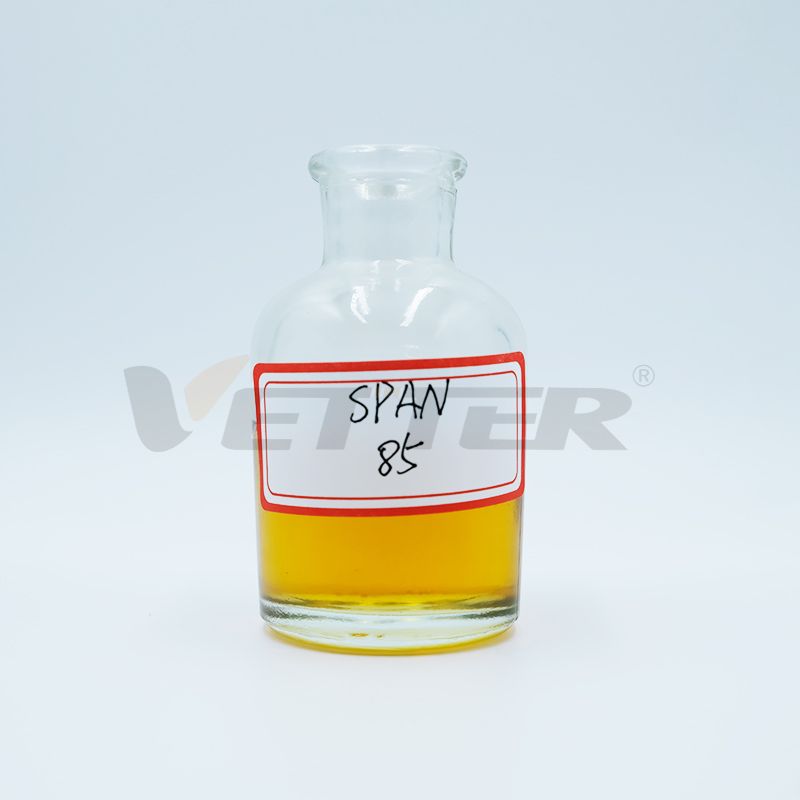
Span 80 Emulsifier, also called sorbitan monooleate, is normally associated with a low hydrophilic-lipophilic balance (HLB) of approximately 4.3. That value explains why it performs well in water-in-oil emulsions but may fail when a formulation needs strong water compatibility. In practical development, the question is not simply whether to use Span 80; it is how to select the right Span 80 emulsifier for W/O emulsions, calculate the required HLB of the oil phase, and control the interfacial film. This article explains how HLB value affects Span 80 performance, including droplet-size distribution, phase separation, viscosity, blending, and quality testing.

The HLB system describes the balance between the water-loving and oil-loving portions of a nonionic surfactant. The Griffin equation is commonly expressed as:
HLB = 20 × Mh / M
Span 80 has an HLB value close to 4.3 because its sorbitan head group is relatively small compared with its oleate chain. It therefore has stronger oil affinity than water affinity. In a typical oil-continuous system, Span 80 aligns at the oil-water interface with its hydrophilic portion directed toward dispersed water droplets and its oleate chain dissolved in the oil phase.
HLB does not measure emulsion strength by itself. It mainly indicates the surfactant’s preferred phase and the type of emulsion it is more likely to stabilize:
| Approximate HLB range | Typical preference | Common formulation role |
|---|---|---|
| 3–6 | Oil-continuous systems | W/O emulsification, wetting, defoaming support |
| 7–9 | Intermediate balance | Wetting and some self-emulsifying blends |
| 8–18 | Water-continuous systems | O/W emulsification and solubilization |
| 13–15 | Strong water affinity | O/W systems, detergency, solubilization |
These ranges are guidelines rather than fixed laws. Oil polarity, temperature, salt concentration, surfactant concentration, shear rate, and the presence of polymers can shift the required HLB.
Using Span 80 at HLB 4.3 in an oil phase that requires an HLB of 10 can produce a coarse or unstable system. The first batch may look uniform immediately after mixing, but water droplets can merge during storage. In contrast, forcing Span 80 into a high-HLB O/W system may lead to poor water dispersibility, incomplete wetting, or inversion during homogenization.
A low HLB surfactant favors W/O structures, but the final stability also depends on whether enough surfactant covers the total droplet surface. For example, increasing Span 80 from 1% to 3% may reduce initial droplet size, but excess surfactant can also lower viscosity, alter sensory properties, or increase migration into the oil phase.
The HLB of Span 80 is a property of the surfactant. The required HLB is the approximate HLB needed by a specific oil or oil blend to form a stable emulsion. Mineral oil, liquid paraffin, vegetable oils, esters, silicone oils, and wax-containing phases do not necessarily have the same required HLB.
For that reason, a supplier specification sheet is useful, but it cannot replace a compatibility test with the actual oil blend and process equipment.
Before testing, prepare a controlled screening system. The objective is to change one variable at a time and obtain data that can be compared between batches.
For supplier comparison, VETTER users should request the batch number, manufacturing date, recommended storage temperature, and certificate of analysis. Span 80 is sensitive to oxidation because of its unsaturated oleate chain, so color, odor, peroxide value, and storage history should be reviewed when a batch performs differently.
Write down whether the product must be W/O or O/W before selecting the surfactant. Also record the target oil content, water content, viscosity, pH, storage temperature, and intended shelf life.
For example, a W/O topical formulation may contain 60% oil and 35% water, while an O/W lotion may contain 20% oil and 75% water. These two systems should not be screened using the same Span 80 level or the same mixing sequence.
Do not estimate the oil phase from a single ingredient. If the oil phase contains 70% mineral oil and 30% isopropyl myristate, the required HLB of the blend should be approximated using a weighted calculation:
Required HLB of blend = Σ(weight fraction of oil × required HLB of that oil)
If mineral oil has a target HLB of 10 and isopropyl myristate has a target HLB of 11, the estimated blend requirement is:
(0.70 × 10) + (0.30 × 11) = 10.3
This is a starting point for screening, not a guaranteed final value.
When Span 80 alone is too lipophilic, blend it with a high-HLB surfactant. The linear blending equation is:
HLB blend = fA × HLBA + fB × HLBB
For a target HLB of 8 using Span 80 at 4.3 and Tween 80 at 15:
Fraction of Tween 80 = (8 − 4.3) / (15 − 4.3) = 0.346
The theoretical blend is therefore approximately:
If the total surfactant concentration is 4% of the batch, the starting quantities are approximately 1.38% Tween 80 and 2.62% Span 80. Because nonideal interactions occur at interfaces, test nearby ratios such as 25:75, 35:65, and 45:55 rather than relying on one calculated point.
Weigh the oil ingredients into a clean vessel. Add Span 80 to the oil phase and mix at approximately 500–800 rpm until the surfactant is visually uniform. If waxes or solid co-emulsifiers are present, heat only to the lowest temperature needed for complete melting, often 5–10°C above the highest melting component.
Record the actual temperature. A 20°C difference can change oil viscosity and droplet breakup, making an HLB comparison unreliable.
Prepare the water phase separately. Dissolve water-soluble ingredients before emulsification and record pH and conductivity. High electrolyte concentrations may change surfactant hydration and interfacial behavior, even with nonionic surfactants.
For a W/O emulsion, add the water phase gradually into the oil phase while mixing continuously. A practical laboratory starting condition is 1–5% of the water phase per minute, followed by a controlled homogenization stage.
For an O/W emulsion, the sequence is usually reversed: add the oil phase gradually into the water phase. Span 80 may still be included as a lipophilic co-emulsifier, but the main emulsifier system normally requires a higher HLB component.
Record rotor-stator speed, batch volume, temperature, and time. For a 500 g laboratory batch, a starting screen might use 8,000 rpm for 2 minutes followed by 12,000 rpm for 1 minute. These values are not universal; they provide a reproducible comparison point.
Do not compare a 30-second high-shear batch with a 10-minute batch and attribute the entire difference to HLB. Mixing energy, impeller geometry, and vessel dimensions can change droplet size by a larger amount than a small HLB adjustment.
Immediately record:
A useful development target is not simply a small D50. A broad distribution with a high D90 can still destabilize because larger droplets rise, settle, or coalesce more rapidly. Report the complete distribution whenever possible.
Use the same container type and fill volume for each test. A practical screening program may include:
| Test | Example condition | What it reveals |
|---|---|---|
| Room-temperature storage | 25 ± 2°C for 4–12 weeks | Normal separation and viscosity drift |
| Heat storage | 40 ± 2°C for 4 weeks | Coalescence, oxidation, and phase inversion risk |
| Centrifuge | Approximately 3,000 rpm for 30 minutes, with RCF reported | Rapid separation tendency |
| Freeze-thaw | Three cycles, for example −5°C to 25°C | Reversibility and structural damage |
Temperature and centrifuge conditions should be justified for the product. A centrifuge result is a screening indicator, not a direct prediction of shelf life.
One anonymized development record from a small topical-formulation project illustrates the practical issue. The engineer initially used 3% Span 80 in an oil phase containing mineral oil, ester oil, and 35% water. The batch appeared uniform after homogenization, but visible water separation developed after 7 days at 40°C.
The development team measured a median droplet size near 18 µm and observed a substantial coarse-droplet tail under microscopy. Instead of simply increasing Span 80, they screened three surfactant ratios while keeping total surfactant concentration at 4%:
| Span 80 : high-HLB surfactant | Approximate blend direction | Observed development result |
|---|---|---|
| 100 : 0 | HLB near 4.3 | Strong oil affinity but water separation after heat storage |
| 75 : 25 | Moderately higher HLB | Improved wetting and smaller visible droplets |
| 65 : 35 | Near the calculated target | More uniform droplet population and no visible separation in the initial 4-week screen |
The final improvement did not come from HLB alone. The team also reduced the water addition rate, kept the emulsion below 35°C during high shear, and matched the homogenization time between samples. This case shows why the correct question is not “Is Span 80 good?” but “Does the Span 80 HLB match the oil blend and process conditions?”
Check surfactant concentration, mixing energy, phase addition rate, temperature, electrolyte concentration, oil oxidation, and container compatibility. A calculated HLB blend may be chemically reasonable but still fail if the total interfacial area exceeds the available surfactant coverage.
A reliable incoming and finished-product inspection program should combine raw-material tests with emulsion performance tests.
Set numerical acceptance criteria before testing. For example, a development specification may require no visible free-water layer after 4 weeks at 40°C, less than 10% viscosity change, and no more than a predefined increase in D90. The exact limits must be tied to the product’s use, regulatory category, and validated shelf-life data.
Problem: Span 80 is used in every oil system because its catalog HLB is known.
Solution: Determine the approximate required HLB of the complete oil blend and screen at least three nearby surfactant ratios.
Problem: The operator increases surfactant from 2% to 6% after observing separation, but the underlying issue is poor phase addition or insufficient mixing.
Solution: Record D10, D50, D90, viscosity, temperature, and mixing energy. Correct the process before increasing the surfactant load.
Problem: A W/O emulsion receives the entire aqueous phase in less than one minute, creating local inversion and coarse droplets.
Solution: Use a metering pump or controlled addition rate. Begin with 1–5% of the water phase per minute and optimize through trials.
Problem: One sample is homogenized at 25°C and another at 45°C. The result is then attributed only to HLB.
Solution: Keep the process temperature within a defined range, such as 30 ± 2°C, unless temperature is an intentional study variable.
Problem: Aged or poorly stored Span 80 causes odor, color, or stability changes that appear to be formulation failures.
Solution: Compare batch certificates, storage history, peroxide value where appropriate, and retain samples. Store the material in a tightly closed container away from heat, light, and air exposure.
Problem: A sample passes 3,000 rpm for 30 minutes and is declared stable for two years.
Solution: Use centrifugation only as an accelerated screen. Confirm performance through real-time and elevated-temperature studies in the final package.
HLB value determines the phase preference of Span 80, but it does not independently guarantee emulsion stability. Span 80, with an HLB near 4.3, is naturally suited to oil-continuous systems; when the oil blend requires a higher value, blending with a high-HLB surfactant can produce a more suitable interfacial film. The most reliable approach combines how HLB value affects Span 80 performance, the selection of a Span 80 emulsifier for W/O emulsions, and the calculation of selecting Span 80 HLB for stable emulsion with measured droplet-size distribution, viscosity, centrifuge behavior, and thermal stability. In practice, the professional terms hydrophilic-lipophilic balance, critical micelle concentration, and droplet-size distribution should be treated as connected development variables rather than isolated specifications, whether the work is performed in a VETTER laboratory or scaled to production.
A: The HLB value is crucial as it indicates the surfactant's preferred phase for stability. Span 80, with an HLB of approximately 4.3, is best suited for water-in-oil (W/O) emulsions. Selecting a surfactant that matches the required HLB of your oil phase is essential for achieving emulsification success.
A: To determine the required HLB, you should calculate the weighted HLB based on the composition of your oil blend using the formula: Required HLB = Σ(weight fraction of oil × required HLB of that oil). This will help you select an appropriate emulsifier like Span 80.
A: If your system requires a higher HLB, it is recommended to blend Span 80 with a high-HLB surfactant, such as Tween 80. This combination can help achieve the necessary interfacial properties for stability in your emulsion.
A: When considering a purchase of Span 80 emulsifiers, check for documented assay, acid value, saponification value, water content, viscosity specifications, and oxidation indicators like peroxide value. This ensures you are getting a quality product.
A: To evaluate stability, you should conduct droplet size distribution measurements, viscosity assessments, and accelerated stability tests under various conditions. This will give you insights into the emulsifier's performance in your specific application.